Maritime Data Guide
Understanding Port Data
A complete guide to maritime ports and port call data — how ports function, what data is captured, and why port intelligence matters for global trade.
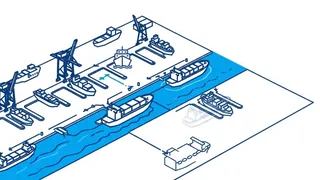
What is Port Data?
Port data records the movement of vessels into and out of ports worldwide. Every time a ship arrives at or departs from a port, this creates a port call record — a fundamental unit of maritime logistics data.
Ports are the critical nodes where maritime trade connects to land-based logistics. With approximately 90% of global trade moving by sea, understanding port activity means understanding the pulse of international commerce.
Port call data enables tracking of cargo movements, measuring port efficiency, predicting vessel arrivals, and analyzing trade patterns — transforming raw vessel positions into structured, actionable intelligence.
Types of Ports
Ports specialize in different cargo types, each with unique infrastructure and operational characteristics.
Container Terminals
Handle containerized cargo using gantry cranes. Measured in TEU (Twenty-foot Equivalent Unit) throughput. Examples: Rotterdam, Singapore, Shanghai.
Bulk Terminals
Handle dry bulk (grain, coal, iron ore) and liquid bulk (crude oil, chemicals, LNG). Use specialized loading/unloading equipment.
Ro-Ro Terminals
Roll-on/roll-off facilities for vehicles, trucks, and wheeled cargo. Vessels have built-in ramps for drive-on access.
General Cargo & Breakbulk
Handle non-containerized cargo like steel, timber, machinery, and project cargo. Often require specialized lifting equipment.
What Happens During a Port Call?
A typical port call involves several stages from arrival to departure. Understanding this sequence helps interpret port data.
Pilot Boarding
Local pilot boards the vessel at the pilot station to guide it through port approaches
Berthing
Vessel is maneuvered to its assigned berth with tug assistance and moored
Cargo Operations
Loading and/or unloading of cargo using port equipment (cranes, pumps, etc.)
Port Services
Bunkering (fuel), provisioning, waste disposal, and crew changes
Inspections
Port state control, customs, and other regulatory inspections if required
Departure
Pilot reboarding, unmooring, and departure from port
Port Call Events
Port data captures three key events for every vessel visit — arrival, time in port, and departure.
Expected Arrival
Predicted vessel arrivals based on AIS destination, speed, and route analysis. Enables proactive planning before vessels reach port.
Arrival
When a vessel enters the port area and begins its call. Detected when a vessel crosses the port boundary and reduces speed.
In Port
The period while a vessel is within the port boundary. Used to track cargo operations, bunkering, or waiting for berth.
Departure
When a vessel leaves the port area. Detected when a vessel crosses the port boundary and increases speed heading outbound.
How Port Data is Collected
Port call data is derived from AIS vessel positions using sophisticated algorithms that detect port entry and exit events.
1
Port Boundaries Defined
Each port has a defined geographic polygon boundary. These boundaries are carefully mapped to include port approaches, anchorage areas, and berths. Our system covers over 6,000 ports globally.
2
AIS Positions Monitored
Vessel AIS positions are continuously monitored. When a vessel crosses a port boundary, the system begins tracking the port call event, recording the timestamp and vessel details.
3
Port Call Record Created
When the vessel departs, a complete port call record is created with arrival time, departure time, dwell duration, and other metadata. This structured data is then available for analysis.
AIS-Based vs. Port Authority Data
AIS-Based Detection
Derived from vessel position broadcasts. Provides global coverage and consistency across all ports. Detection accuracy depends on port boundary definitions and AIS signal quality.
Port Authority Data
Supplied directly by port operators. Can offer more precise berth-level detail and official timestamps. However, availability varies by port and data formats are not standardized.
Port Data Fields
Here are the key data fields typically available in port call records.
| Field | Description |
|---|---|
| Port Code | UN/LOCODE identifier for the port |
| Port Name | Full name of the port |
| Arrival Time | Timestamp when vessel entered port area |
| Departure Time | Timestamp when vessel left port area |
| Dwell Time | Duration vessel spent in port |
| Berth Location | Specific berth or terminal coordinates |
| Previous Port | Last port visited before arrival |
| Next Port | Destination port after departure |
| Vessel Type | Type of vessel calling at port |
| Draft on Arrival | Vessel draft when entering port |
Understanding UN/LOCODE
Ports are identified using UN/LOCODE — a standardized coding system maintained by the United Nations.
What is UN/LOCODE?
UN/LOCODE (United Nations Code for Trade and Transport Locations) is a 5-character code used to identify ports, airports, and inland freight terminals worldwide. The format is:
XXXXXFirst 2 characters: Country code (ISO 3166-1 alpha-2)
Last 3 characters: Location code
Last 3 characters: Location code
NLRTMRotterdam, Netherlands
SGSINSingapore
CNSHAShanghai, China
USNYCNew York, USA
DEHAMHamburg, Germany
AEDXBDubai, UAE
Why Port Data Matters
Port call data enables a wide range of maritime analytics and logistics applications.
Supply Chain Visibility
Port data reveals when cargo actually arrives and departs, enabling accurate tracking of goods through the maritime leg of supply chains. This visibility helps reduce uncertainty and improve planning.
Port Congestion Monitoring
By analyzing dwell times and vessel queues, port data helps identify congestion before it impacts operations. Rising average dwell times often signal developing bottlenecks.
ETA Predictions
Historical port call patterns enable more accurate arrival predictions. Knowing typical turnaround times at intermediate ports improves forecasts for final delivery.
Trade Flow Analysis
Tracking which vessels call at which ports reveals commodity movements and trade patterns. This intelligence is valuable for market analysis and planning.
Want to Work with Port Data?
Explore how maritime data APIs make port intelligence accessible for your applications.
New to maritime data? Start with our AIS Data Explained guide.
Learn about port analytics use cases on our Port Analytics page.